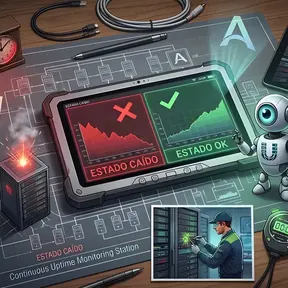
Playing Russian Roulette with Your Website? Why You Should Never Make “Live” Changes
Updating your website live and crossing your fingers? Discover the dangers of editing in production and how DapSite uses Staging environments to protect you.
In short
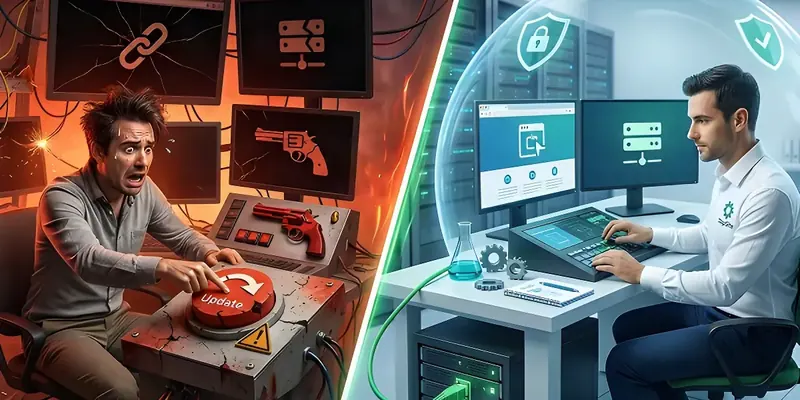
Changing, installing or updating directly on your public website is betting your business that nothing goes wrong: a conflict shows the white screen to every customer, a silent error can break the checkout button and another can corrupt the database. Professionals test on staging first.
In this article
It is a Tuesday at 2:00 PM. You are checking your website and see a pending update for your main theme, or perhaps you decide to install a new tool to add a WhatsApp button. You click “Update” or “Install.” Suddenly, the page reloads and… a blank white screen. Your website is gone.
If you have ever felt that drop in your stomach, you know what we are talking about. Making changes, installing tools, or updating code directly on your public website (what developers call “in production” or “live”) is the digital equivalent of playing Russian roulette.
At DapSite, we refuse to gamble with our clients’ businesses. That is why implementing changes directly on a live site is a practice we strictly forbid.
The 3 Common Disasters of “Live” Editing
When you tweak code or update elements on a website that is receiving real-time traffic, you expose yourself to unnecessary risks:
1. The “White Screen of Death”
It is the most dreaded error in websites. It happens when a new tool conflicts with your existing code. By doing it live, you are not the only one who sees the white screen; all your potential customers see it too, destroying your business’s credibility in seconds.
2. Broken Shopping Carts (Without You Noticing)
Sometimes the error isn’t so obvious. You update a tool live, the website seems to work fine, but three days later you realize no one has bought anything. You discover that the update broke the “Checkout” button on the final step. How much money did you lose in those three days?
3. Irrecoverable Data Loss
If you make a live change that corrupts your database and you don’t have a very recent backup (from a couple of hours ago), you will lose blog posts, new user registrations, or recent orders when you try to restore the system.
The Professional Golden Rule: The Staging Environment
Professionals don’t cross their fingers and hope for the best. They use something called a Staging Environment.
A Staging environment is an exact, hidden clone of your website. It is a “digital laboratory” where we can run the riskiest experiments without your customers ever noticing.
With DapSite’s Support Plans, this is our standard protocol:
| Action | The Amateur Method (Live) | The DapSite Method (With Staging) |
|---|---|---|
| Updating a complex tool | Click, pray, and hope nothing breaks. | We clone the site, update, test everything, and then push the change to the live site. |
| Changing a page design | Customers see a half-built website. | We design in private. Once approved and perfect, we publish it in a second. |
| If something fails… | You panic, lose sales, and seek urgent help. | Nothing happens. We delete the clone, the real site is unaffected, and we find another solution. |
Conclusion: Your website is not a testing lab
Your public website is your business’s main stage, not the place to rehearse. Every update, no matter how harmless it seems, has the potential to break your site.
Are you crossing your fingers every time you click “Update”?
Eliminate the risk and the anxiety. With a DapSite Support Plan, we manage your website using secure Staging environments. Your customers will always see a perfect page, while we work safely behind the scenes.
If you would rather have someone handle this for you, see our WordPress maintenance service.
Frequently asked questions
What does making “live” changes to a website mean?
It means modifying your public site directly while it's receiving visitors: installing a tool, updating the theme, or touching the code in what developers call “production.” If something goes wrong, the error is visible to all your customers in real time. That's why it's compared to playing Russian roulette with your business.
What is a staging environment?
It's an exact, hidden clone of your website, a kind of digital lab where the riskiest tests can happen without your customers noticing. Updates are applied there, everything is checked, and only then is the change pushed to the public site. If something fails, the clone is discarded and your real site is never affected.
What is the “white screen of death”?
It's one of the most feared website errors: the page loads completely blank, usually because a new tool conflicted with your code. If it happens on the live site, you're not the only one who sees it; all your potential customers see it too, and your business's credibility is ruined in seconds.
Why do I need a recent backup before any change?
Because if a change corrupts your database and your latest backup is old, restoring it means losing everything that happened since: blog posts, new user registrations, or recent orders. With a backup from just a few hours ago, the damage is minimal. Every DapSite plan includes daily backups.